


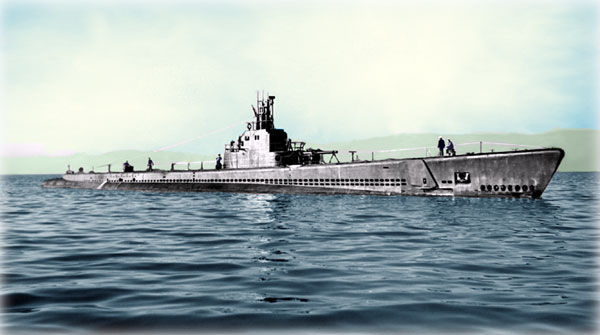
HERRING (SS-233)
Compiled by Paul W. Wittmer and Charles R. Hinman, originally from:
U.S. Submarine Losses World War II
NAVPERS 15,784, 1949 ISSUE
Please note: On June 1, 2026, the US Navy officially confirmed the identification of the final resting place of the crew of USS Herring (SS-233). Original reports of the discovery off the coast of Matua Island in Russian territorial waters were made by the Russian Navy in 2017 and reported to the U.S. delegation at the Joint 21st Plenum U.S.-Russian Joint Commission on POW/MIAs in 2018.
For information and photos of the wreck, please see The Discovery of the Wreck of USS Herring (SS-233) on this site, and Wreck Site Identified as USS Herring (external site) for the press release from NHHC.
HERRING, under LCDR David Zabriskie, Jr., left Pearl Harbor on 16
May 1944 to conduct her eighth patrol in the Kurile Islands. On 21 May
she topped off with fuel at Midway and departed for the Kurile region.
No word was received from HERR ING direct after her departure from
Midway, but she did accomplish a rendezvous with BARB on 31 May 1944. These two boats were to patrol the Kurile Islands area cooperatively,
and at the rendezvous, as recorded in BARB's report of her eighth war
patrol, the areas for which each was to be responsible were delineated.
A few hours after leaving HERRING early on the afternoon of 31 May, BARB
made contact with two Japanese merchantmen. While developing the
contacts BARB heard distant depth charging, which she took as an
indication that HERRING was making an attack. Later that evening BARB picked up a prisoner who revealed that
HERRING had sunk the escort vessel of the convoy BARB had been
attacking. The ship sunk was ISHIGAKI, a new type DE built in 1942, and
it was sunk with one torpedo hit. The sinking resulted in the scattering
of the three ship convoy and two ships, which subsequently passed near
BARB, were sunk by her. Post-war information reveals that HERRING sank
the third merchantman of the convoy. On 3 June 1944 orders were sent to BARB and HERRING directing them to
stay outside of a restricted area in which friendly surface ships would
be operating during the Marianas Campaign. A receipt was required for
this message, but none was heard from HERRING. BARB was unable to
contact her after 31 May. Consequently on 27 June, Midway was directed
to post a sharp lookout for HERRING, which might be returning without
ability to transmit by radio, and was expected by 3 or 4 July. When she
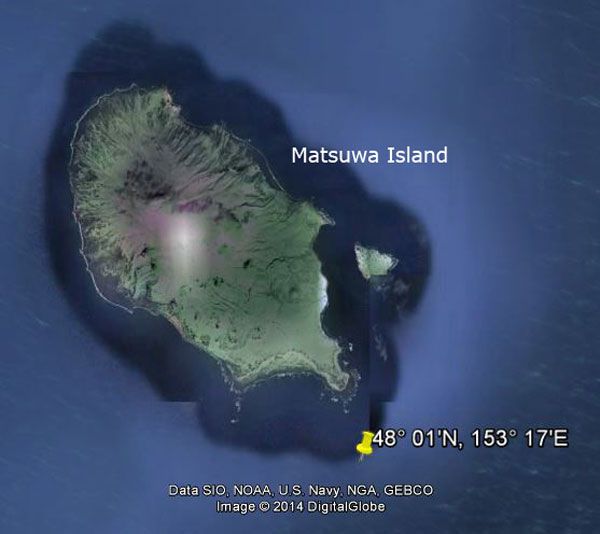
had not appeared by 13 July 1944, HERRING was reported as presumed lost. Japanese information indicates that HERRING was sunk on 1 June 1944,
two kilometers south of Point Tagan on Matsuwa Island in the Kuriles.
The report states that two merchant ships, HIBURI MARU and IWAKI MARU,
were sunk by American torpedoes while at anchor at Matsuwa. In a
counter-attack, a shore battery scored two direct hits on the conning
tower, and "bubbles covered an area about 5 meters wide, and heavy oil
covered an area of approximately 15 miles". The position of this attack
was around 150 miles from the position where HERRING met BARB; the
attack occured on the day after the BARB picked up her prisoner. BARB
and HERRING were the only U. S. submarines in the area at the time and
BARB did not make the attack on the anchored ships referred to above. As
a result of the attacks reported by BARB and by the Japanese, HERRING
has been credited with four ships and 13,202 tons sunk for her last
patrol. Google Earth image For her first seven patrols, HERRING sank nine ships, totaling 45,200
tons, and damaged two, totaling an additional 8,400 tons. Her first four
patrols were in the Atlantic, the first three off the coast of Spain,
and the fourth near Iceland. The first netted an Axis freighter, while
on the second HERRING saw no enemy ships. Her third patrol saw her sink
a Nazi U-boat, and her fourth was again unproductive of enemy targets.
Her fifth patrol was the passage from the United Kingdom, where she had
been based for her Atlantic patrols, to New London, Conn., thence to
Pearl Harbor. She patrolled the East China Sea on her sixth war run,
and sank two large transports, a freighter, and a small escort type
vessel. HERRING's seventh patrol was in the area just south of the
Japanese home islands; here she damaged a destroyer type vessel.
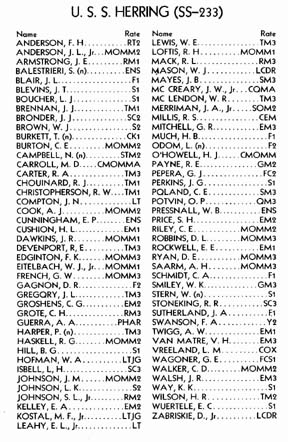
Click here for complete and accurate listing of men lost on USS Herring
See also Ed Howard's Final Patrol page on USS Herring (external link).
Home Presentation WWII Pre-WWII Post-WWII Sources
Related Links Privacy Contact Us
